 ReelAtlas
Guides
Clusters and anywhere pays. When do symbols have to touch?
Follow six identical symbols on one grid and see how shared sides, total counts and collection rules change what gets counted.
On this page
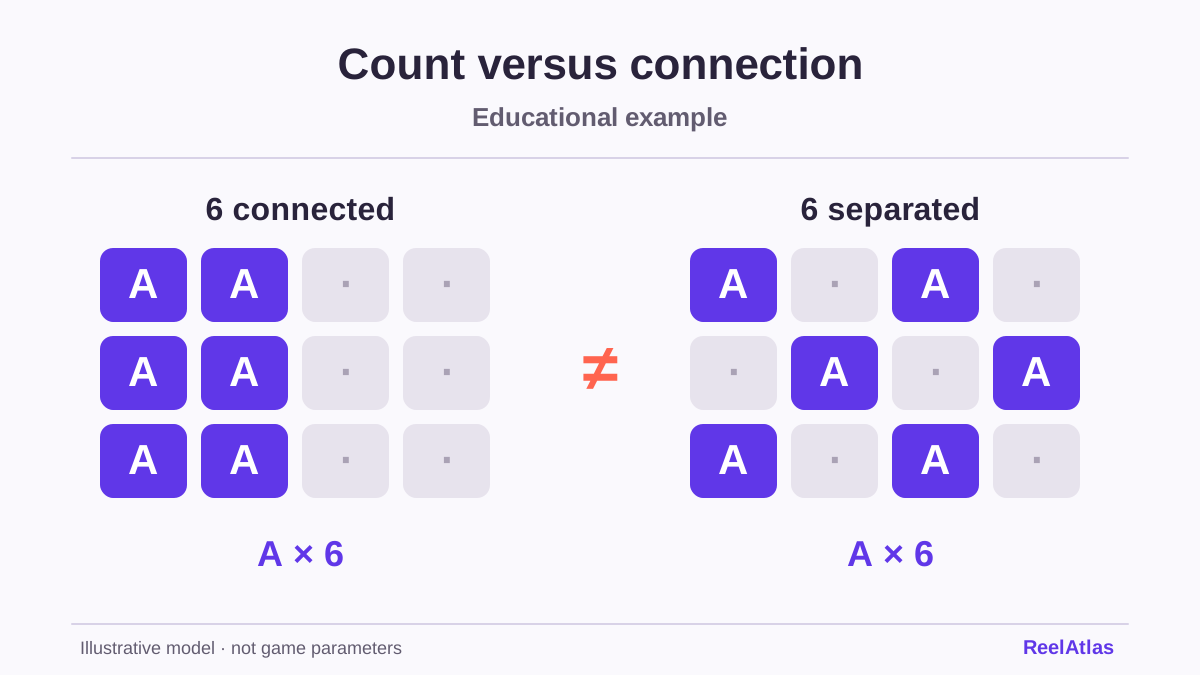
Six identical symbols are visible on the board. The total is easy to check, but it still leaves a question. Do the symbols have to form a single connected group? The answer changes which cells the game evaluates together. This example uses a board we made up for the comparison, with three rows and four columns. The letters are placeholders, and the threshold belongs to our example.
- Top row — A A B C
- Middle row — B A B A
- Bottom row — C B A A
Trace a group along shared sides
Start with the A in the top left. Moving along shared sides takes you to the next A in the top row and from there to the A in the middle row. The three As in the lower right form a second group. The groups meet at a corner, which our example excludes. If the rule requires four As in one connected group, neither group qualifies. Play’n GO’s Reactoonz is an example of a game that evaluates clusters of matching symbols.
Count the whole board
Under an anywhere rule with the same threshold of four, count all six As. Now swap the B in the bottom row’s second column with the A at the end of the middle row. The new bottom-row A links the two groups through shared sides, so the cluster rule now counts all six together. The anywhere count stays at six. Play’n GO’s description of Viking Runecraft 1000 and Pragmatic Play’s description of Sweet Bonanza both give examples of board-wide matching.
Read the trigger or collector separately
A paytable may use scatter pay for a board-wide count of ordinary matching symbols and list a Scatter icon under a separate feature rule. For collection, look for what takes the symbols or values and where they go, such as into a meter. A change in that meter alone says little about how the game evaluated the grid. Also check that the instructions describe the same phase of the round.
Look at the grid before the animation
A cascade can replace symbols after either kind of evaluation. Freeze the sequence just before the first removal and identify what qualified. The next layout is a separate step in the example. The six As describe the layout in front of us. To know how often it could appear, we would need the game’s model for producing layouts.