 ReelAtlas
Mechanics
Cluster pays: counting connected symbols
Six identical icons may form more than one cluster. A 3×3 board illustrates adjacency and minimum group size.
On this page
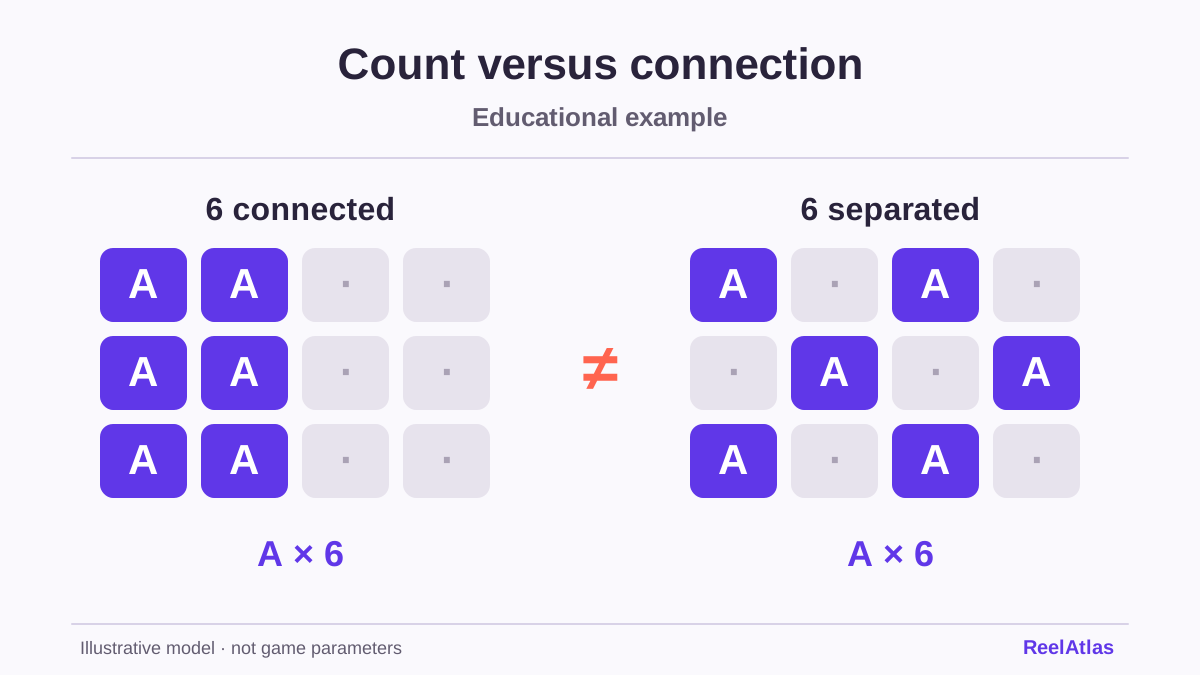
Cluster pays evaluates groups of symbols that meet a connection rule. Counting all identical icons on the screen can give the wrong answer. You also need to know which cells count as neighbours and how large a group must be. A small fictional board makes the difference visible.
Six As in three groups
Our board has three rows. The top reads A B A, the middle A A B and the bottom A B A. In this exercise, cells connect only if they share a side. A diagonal touch does not connect them. Each game has its own rule.
Start at the top-left A. It connects to the A below, which in turn connects to the A on its right and the A in the bottom-left corner. This group has four cells. The A in the top-right corner is separate, as is the A in the bottom-right corner. We see six As in total, in groups of 4, 1 and 1.
If the rule requires five cells in a single group, none qualify. A rule that simply counts every A anywhere on the board would give a different answer. This distinction matters when reading cluster pays and anywhere pays rules.
One cell can join two groups
Change the B in the middle of the top row to A. The new cell connects the group of four to the top-right A, creating a group of six. The bottom-right A stays separate because a diagonal touch still does not count in our exercise.
This example shows how to trace connections on a given board. The probability of generating that board requires a model of how the symbols are placed. Board size and the cluster threshold supply only part of that information.
Evaluate the cluster, then follow the cascade
First establish whether a group qualifies for a payout. Then check whether those symbols disappear, how the board refills and when it is evaluated again. The cascade describes what changes on the board after evaluation and can be read separately from the cluster rule.
The official Reactoonz description specifies a 7×7 board and groups of at least five identical symbols. The game page shows how a cluster model is used. Our 3×3 example has its own rules, and any exceptions in Reactoonz require documentation.
Four questions for the rule sheet
- Does a connection require a shared side, or does a diagonal count?
- Is each separate group evaluated on its own?
- How do Wilds and larger symbols affect connectivity and group size?
- What happens to the group after scoring, and when do counters reset?
Once you have those answers, you can compare two titles by their actual rules. The Reactoonz card, the guide to cascades and the explanation of paylines and ways each cover a different part of how a qualifying combination is formed and evaluated.
Sources
- Play’n GO: ReactoonzChecked