 ReelAtlas
Mechanics
Cascades and tumbling: how a sequence is evaluated
What disappears from the grid, when new symbols arrive and why several cascades need not involve several stakes.
On this page
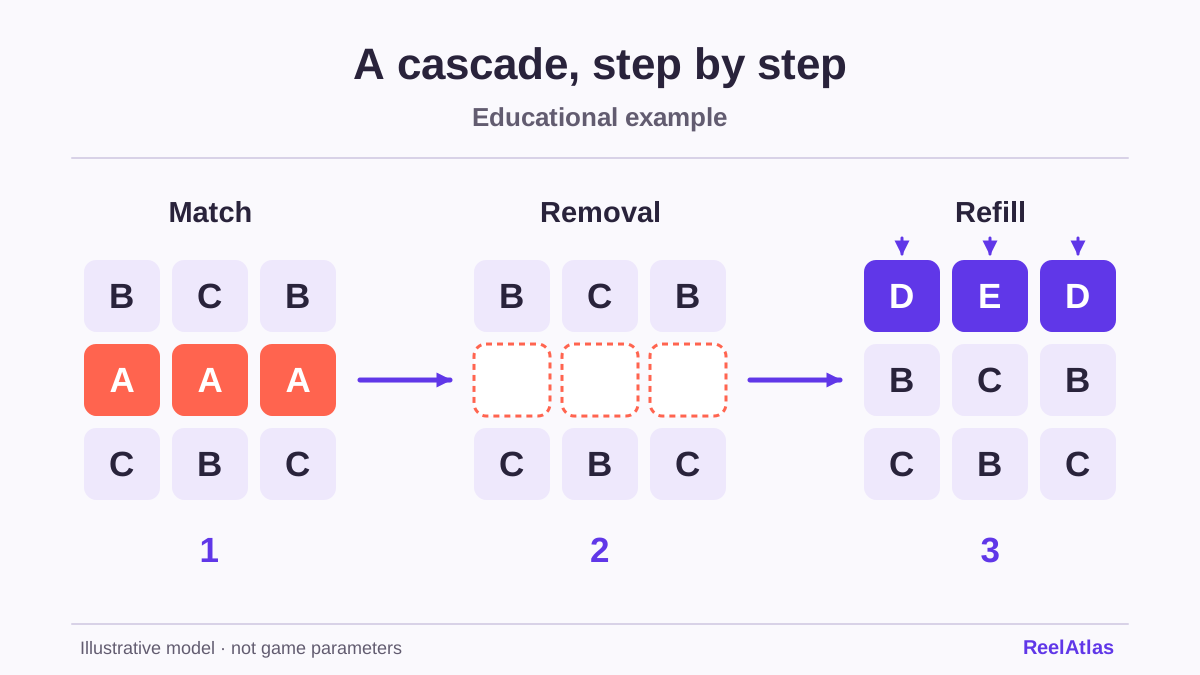
A cascade changes the grid after a combination is evaluated. Some symbols disappear and empty positions are filled. The rules for the specific game determine which symbols disappear and when the sequence ends.
Follow one sequence
- The initial grid appears.
- The game identifies combinations under its scoring rules.
- The specified symbols are removed and the positions refilled.
- The new grid is evaluated. The sequence ends when the condition for another stage is no longer met.
In its Sweet Bonanza announcement, the studio describes winning symbols being removed and new symbols falling in from above. This illustrates tumbling in a specific title.[1]
Round, cascade and bonus feature
Use a consistent unit when comparing records. One paid round may include several cascades. A bonus feature may contain multiple spins. Counting grid changes alone does not tell you how many stakes were charged.
Check when the multiplier applies
A multiplier may apply to a particular combination, the sequence total or another component specified in the rules. Establish its scope before calculating. Multipliers from successive stages are not necessarily multiplied together.
Suppose the returns total 5 and the multiplier values are 2 and 3. An illustrative rule that adds them gives a final factor of 5 and a result of 25. A rule that multiplies them gives 30. The rules determine the operation. The animation alone cannot tell you which applies.
Same animation, different scoring
Cascades can accompany different ways of forming combinations. First check whether the game counts lines, connected groups or symbols anywhere. Then describe how the grid changes after a combination. A full explanation needs both.
What to record
- The initial cost and where the round begins and ends.
- The result of each stage and how results are added.
- The multiplier rule and which part it applies to.
- The full title and mode when comparing releases.
A long cascade sequence alone tells you neither the RTP nor how one title compares with another. It records the course of one round. Statistical conclusions require a distribution and a clearly defined sample.