 ReelAtlas
Mechanics
RTP: calculating and interpreting average return
What 96% RTP means, how it differs from a session result and why a deposit differs from total stakes.
On this page
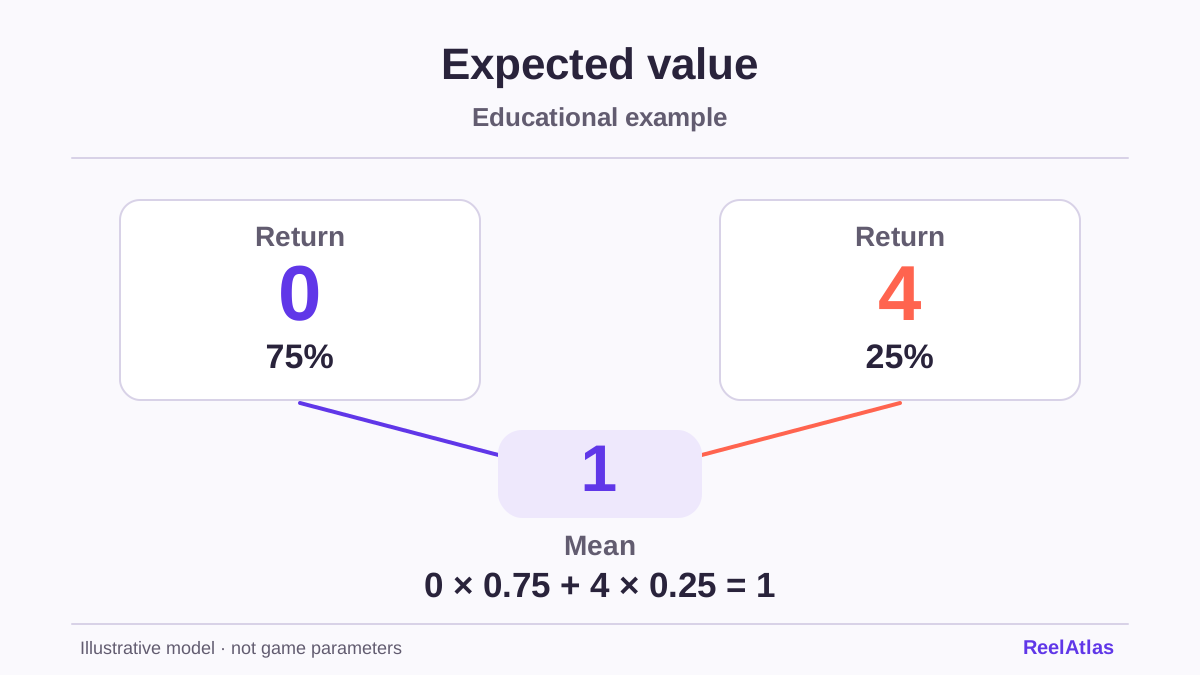
RTP, or return to player, describes the theoretical average return relative to the stakes in a game model. A figure of 96% gives no guarantee that a particular deposit will return 96% of its value. The British regulator describes it as a long-run average, with individual sessions varying around it.[1]
A simple distribution worked through
In our educational model, one trial costs one unit. It returns two units with a probability of 40%, two units with a probability of 8%, and zero with a probability of 52%. The average return is 0.40 × 2 + 0.08 × 2 + 0.52 × 0 = 0.96. Divide by the cost of 1 to get 96%.
The first two branches can be combined as a 48% chance of returning two units. Listing them separately shows how the average adds values weighted by probability. A real model needs all branches, including bonus features.
Deposits and total stakes are different amounts
Start with 20 units. You complete 50 trials at one unit each, reusing earlier returns. The total cost of the trials is 50, even though the starting amount was 20. The theoretical average applies to those 50 units staked.
Return observed in a sample
If a recorded sequence cost 50 and returned 37, the observed return was 74%. That does not establish an RTP of 74%. A short sample differs from a model parameter. Variability helps explain the spread across possible samples.
Tie the figure to its configuration
Record the full name, source, version and mode. When two sources show different values, first check what each one covers. Avoid averaging conflicting values or picking the larger value simply because it looks more attractive.
Use the average-return lab to explore this calculation and the spread lab to compare distributions. We cite the British regulator for the statistical definition. Its account of domestic rules applies to its own jurisdiction.