 ReelAtlas
Guides
RNG in slots | The generator, outcome and animation
Random numbers do not imply equal payouts. A simple model shows what you can check in an RNG description and what a run of outcomes cannot establish.
On this page
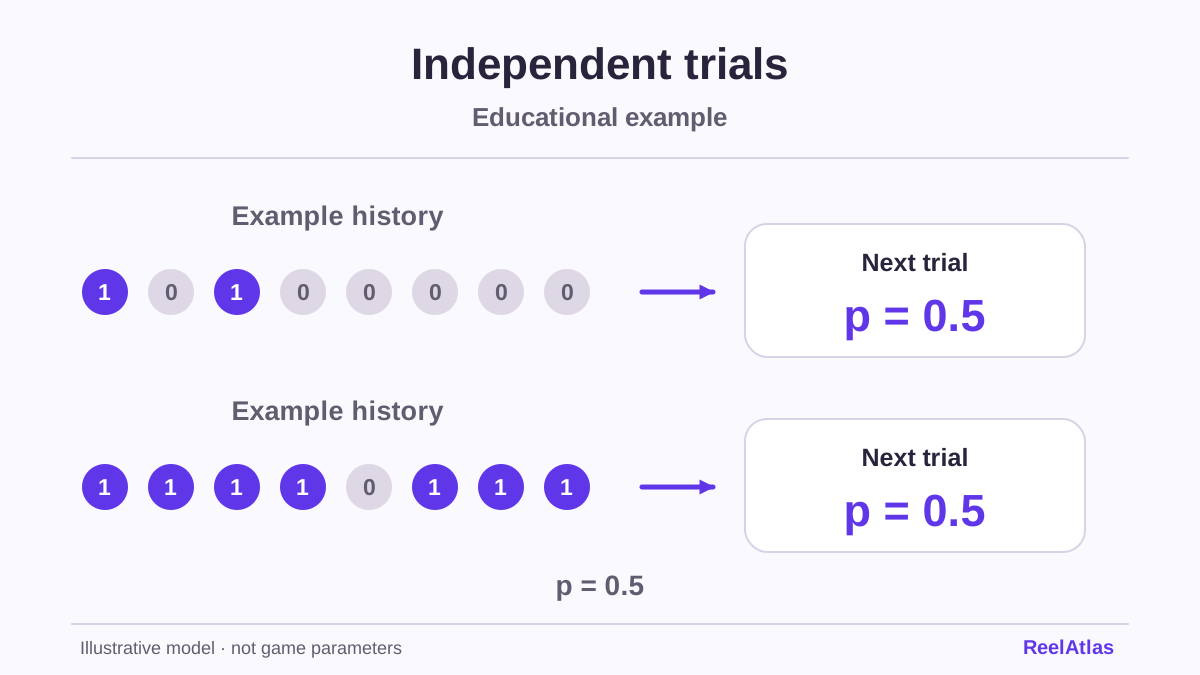
RNG stands for random number generator. The label alone does not explain a paytable or what appears on screen. Separate three layers: generating numbers, mapping them to outcomes and presenting the outcome. Each layer calls for different information.
Equal chances for numbers, unequal payouts
Consider a small educational model. The generator picks a number from 0 to 99, each equally likely. The rule maps 0 to 79 to outcome A, 80 to 98 to B and 99 to C. The outcome probabilities are 80%, 19% and 1%, respectively.
The generator is uniform over its range, but the three outcomes have different probabilities. Their frequencies depend on the mapping as well. A claim that “all symbols are equally likely” based solely on the presence of an RNG skips that step.
With returns A = 0, B = 2 and C = 10, the expected return is 0 × 0.8 + 2 × 0.19 + 10 × 0.01 = 0.48 units. This calculation uses our assumptions and does not give a catalogue game’s parameter. Changing the mapping or payouts changes the calculation even when the generator’s range stays the same.
What one technical standard requires
In RTS 7, the UK Gambling Commission discusses unpredictability, distributions that match theoretical probabilities and correct mapping from numbers to outcomes, among other things. The document restricts adaptive changes to probabilities during play. It distinguishes such interventions from special features specified in the rules.
We cite RTS 7 as an example of technical requirements. It does not establish German authorisation or prove that every ReelAtlas title underwent a particular audit. Verifying an implementation requires documentation for that product, version and scope of examination.
An animation cannot show the whole model
A screen recording lets you describe the visible sequence. It does not automatically reveal the weights of every outcome, how the generator is initialised or what a certification covers. A long run of similar symbols likewise does not establish whether the system works correctly. First identify the property you are examining and the data you need.
In a model of independent trials, the previous outcome leaves the next probability unchanged. If a feature carries state, such as a stored multiplier, describe its rules separately. A feature rule gives no assurance that earlier losses will be balanced out.
How to read a verification claim
- Find the name and version of the product examined.
- Distinguish generator documentation from documentation covering the whole game.
- Check the scope, date and issuer.
- Look for confirmation from the issuer if it is publicly available.
- A graphic labelled “certified” is insufficient evidence on its own.
Next, read about independent rounds or Monte Carlo simulation. The first guide addresses how to interpret a history. The second shows a model with explicit assumptions. Both help you ask more precise questions and neither predicts the next slot outcome.