 ReelAtlas
Guides
Why a run of results cannot predict the next round
An example with a 20% probability, ten unmarked draws and the limits of inference from a short run.
On this page
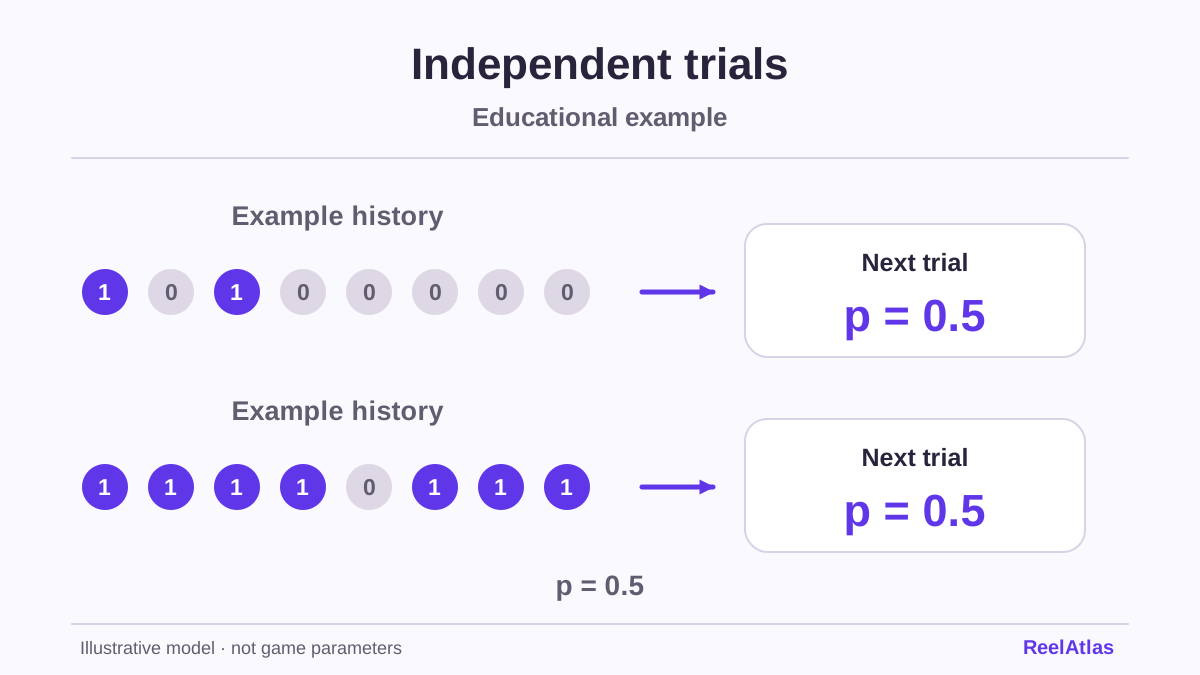
If trials are independent and their probabilities are fixed, previous outcomes leave the probabilities of the next trial unchanged. This is an assumption of a particular mathematical model. It does not audit every game or describe every feature.
Establish the assumptions before calculating
Imagine drawing a token from a bag. Two of the ten tokens are marked. After each draw you put the token back and mix the contents thoroughly. In this model, each draw has a 20% chance of a marked token and an 80% chance of an unmarked token.
Replacing the token keeps the bag’s contents and the draw probabilities the same. A binomial model describes the number of marked results in a fixed number of independent trials.[1]
Ten unmarked draws are possible
The probability of ten unmarked tokens in a row is 0.8 to the power of 10, or about 10.74%. That is more than one in ten ten-draw sequences in this model. A long run can occur by chance.
After seeing that run, the next draw still has a 20% chance of a marked token. Replacing tokens does not create a mechanism that balances outcomes for a particular person.
What changes without replacement
When you draw without replacing tokens, the contents of the bag change. After drawing one unmarked token, two of the nine remaining tokens are marked. The probability that the next token is marked is 2/9. This model has different assumptions, so the earlier calculation must change.
In a game, distinguish an ordinary round from a feature that carries state, such as collected items, a stored multiplier or spins remaining. The rules explain those dependencies. The label RNG alone cannot stand in for those rules.
A video of a run cannot verify a generator
A recording of twenty rounds lets you describe those twenty rounds. It does not reveal the algorithm, all possible outcomes or their probabilities. Selecting only the most striking parts changes the impression the recording gives.
- Note whether the recording shows the full sequence and all costs.
- Separate observation from assumption. “I saw ten zeros” is an observation.
- Check whether the mode or feature state changed along the way.
- Do not treat the run as a promise that the next round will balance it out.
For learning, use models with visible assumptions, such as those in our lab. These give you access to assumptions an ordinary game recording cannot show. The calculations can help you spot an invalid inference and do not predict a game result.
Sources
- NIST: binomial distributionChecked