 ReelAtlas
Mechanics
Slot multipliers: what exactly does 5× multiply?
Adding multipliers, applying them in sequence and limiting them to one stage. Worked examples show why the order matters.
On this page
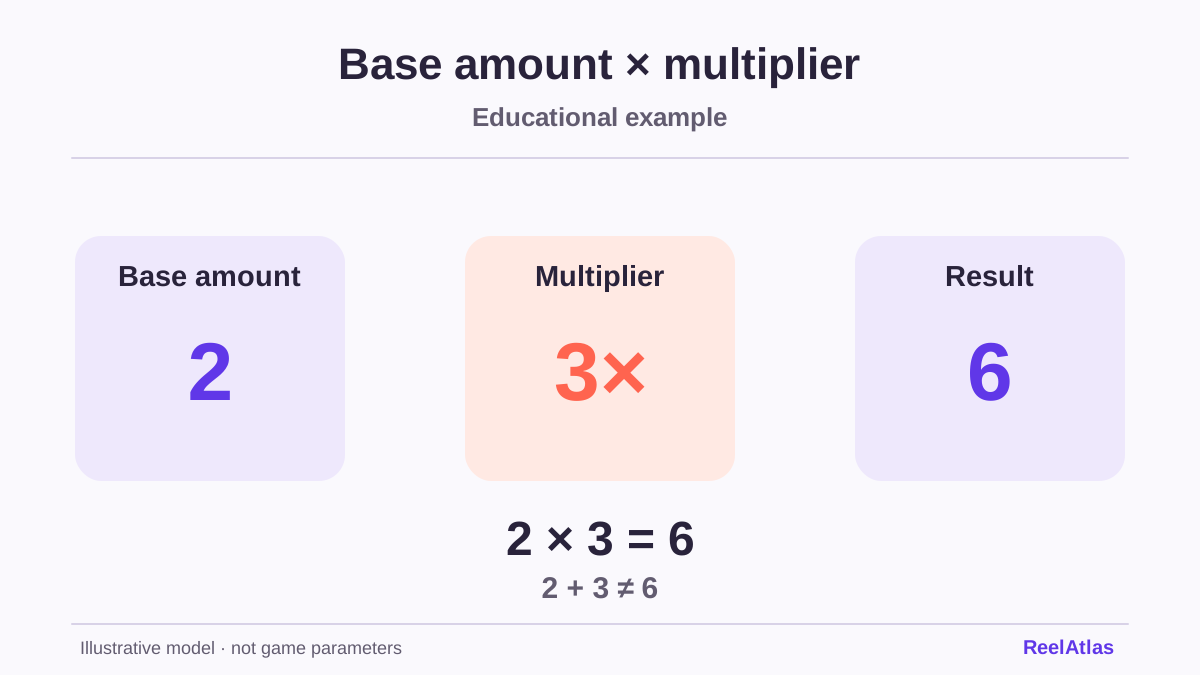
A 5× label without a base leaves the calculation incomplete. It might apply to one combination, one stage, the sum of several cascades or another amount defined by the rules. First identify the amount the multiplier applies to.
Adding factors or applying them in sequence
In the first fictional model the base value is 4 units. Two factors appear, 2× and 3×. The rules say to add them and apply the sum to the base, giving 4 × (2 + 3) = 20.
The second model uses the same figures but applies the factors in sequence, giving 4 × 2 × 3 = 24. The icons alone cannot tell you which calculation to use. Look for the rule on how multipliers combine. Each game defines its own method.
A multiplier can apply to one stage only
Suppose a round has two payouts. The first is 2 units. The second has a base of 4 units and a 3× multiplier. If 3× applies only to the second payout, the total is 2 + 4 × 3 = 14. If it applies to both, the total is (2 + 4) × 3 = 18. These are different models.
Record the stage, base, multiplier and resulting amount before adding the stages. If the interface already shows the multiplied amount, applying 3× again would overstate the total. The labels on the counters tell you what the figures represent.
When the counter rises and when it resets
Some features keep a running state. The multiplier changes after an event defined in the rules. Record both when it increases and when it resets. A cascade, a round and a feature can end at different points. Name the event precisely.
The studio’s description of Gonzo’s Quest gives different multiplier ranges for the base game and Free Fall. Check which mode is active. The game card links to the source, and values from one mode need not carry over to the other.
A multiplier is not a probability
If the rules specify “up to 10×”, that tells you the range of the feature. It gives neither the frequency of the multiplier nor the average return. The largest multiplier also need not equal the maximum payout for the game. The base value and any cap on the total matter.
- What event awards the multiplier?
- Which amount or combination does it apply to?
- Are factors added, replaced or applied in sequence?
- When does the counter change and reset?
- Is there a separate cap on the final result?
Try the two-stage example. Can you multiply the final 14 by 3 again? No, the calculation already includes that factor. Our guide to paytables explains how to separate the amount for one stage from the total for the round.
Sources
- NetEnt: Gonzo’s QuestChecked