 ReelAtlas
Guides
Slot glossary | 20 terms from game rules
Wild, scatter, RTP, paytable and 16 other terms, with explanations and questions to ask when reading game rules.
On this page
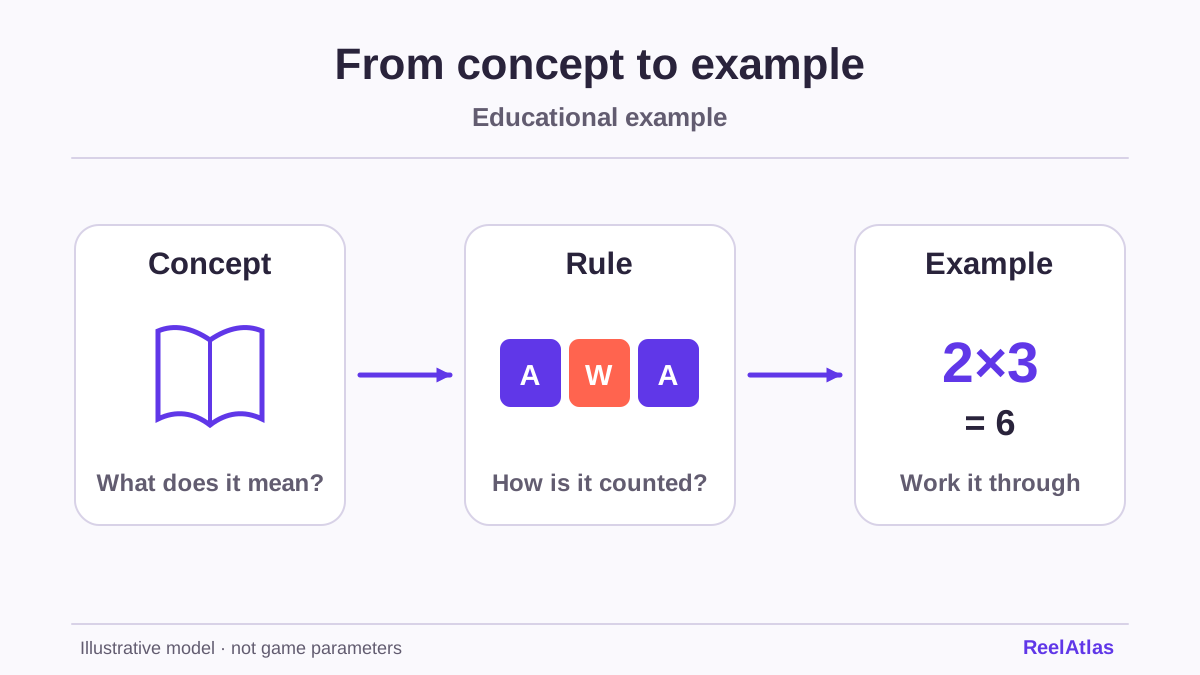
Game rules mix names, abbreviations and numbers ending in x. You can read every word and still be unsure what was calculated. This glossary groups twenty terms by their roles. Each comes with a question that takes you from the label to the specific rule.
Establish the unit first
- Stake / bet: The amount staked. Does it cover the whole round, one line or another unit specified in the rules?
- Total bet: The total stake for a round. Use it as the reference when comparing cost and return.
- Paytable: A table that pairs a qualifying arrangement with a value. Check the unit for that value.
- x bet: A multiple of the stake. Which stake does it multiply, and does it apply to the entire result or only part of it?
- Payout / win: The amount paid or returned when an outcome is scored. A positive payout can still leave a negative net result after cost.
For example, a return of 0.8 units against a cost of 2 leaves a net result of minus 1.2. The screen may highlight a hit, but the financial record needs the cost too. Keep a payout from one combination separate from the total for all stages of a round.
Read the arrangement next
- Reel: Usually a visible column of symbols. The number of columns alone does not identify the scoring model.
- Payline: A defined path through cells on the grid. Check the reading direction and minimum match length.
- Ways: Combinations of matching positions on the required reels. Their count describes the structure and cannot give a probability of winning by itself.
- Cluster: A group of symbols that meets a connection rule. Check whether shared edges, diagonals and substitute symbols count.
- Wild: A symbol that substitutes for others. The exceptions can matter just as much as the permitted substitutions.
- Scatter: A symbol scored under a separate rule. Its behaviour can vary by game.
Check what happens next
- Cascade / tumble: Scored symbols are removed and the grid refills. This is a stage in the sequence and does not by itself establish a new stake.
- Respin: Another spin triggered by a feature rule. Check what stays in place and what is drawn again.
- Multiplier: A factor applied to a value. You need its base, scope and timing. A label such as 5x gives none of those details.
- Free spins: Additional spins awarded as part of a feature. The name gives neither the probability of triggering the feature nor the overall return of the game.
- Retrigger: Restarting or extending a feature after another condition is met. Record the condition and the increase in the counter separately.
Numbers that describe the model
- RTP: The theoretical ratio of expected return to cost. It applies to a specific model and makes no promise about a short session.
- Volatility: The spread of outcomes. Studio labels may use different scales.
- Hit frequency: How often an event defined as a hit occurs. Check whether it requires a positive return or a positive net result.
- Max win: The maximum outcome specified in the rules. Its frequency is unknown without a probability.
Two terms to keep separate
A feature describes behaviour, while a configuration specifies a set of parameters. A feature name cannot identify the RTP version. If a screenshot gives only the title, record the configuration as “undetermined”. The related materials lead to the paytable, multipliers or a game page that uses the term. Read the term alongside its rule instead of inferring the rule from a familiar word.